2025-12-30 · 6 min read
Sunbest-MBT (bisoctrizole): an overview
Bisoctrizole (MBBT) profiled: a particulate organic filter that works mainly by absorbing UV, with safety data, use levels and market-by-market approval status.
Sun care · Formulation · Regulatory
Abstract
Background. Ultraviolet radiation is the part of the electromagnetic spectrum reaching Earth at wavelengths shorter than visible light, invisible to the eye. UV-A is the longer-wave band, causing lasting skin damage and photo-ageing and contributing to skin cancer risk. UV-B is shorter-wave, causing sunburn and direct DNA damage.
Result. Sunscreens combine several UV filters to keep that radiation from reaching living skin. Because no single filter covers 290–400 nm evenly, and the two bands damage skin differently, filter selection determines how a formula performs across the spectrum.
The American Academy of Dermatology recommends broad-spectrum protection at SPF 30 or higher, applied generously and reapplied. Bisoctrizole is one of the filters used to build such formulas.
Introduction
The generic name of the active is bisoctrizole (USAN), supplied by Vinner Labs as Sunbest-MBT.
- INCI name: Methylene Bis-Benzotriazolyl Tetramethylbutylphenol
- Chemical name: 2,2′-methanediylbis[6-(2H-benzotriazol-2-yl)-4-(2,4,4-trimethylpentan-2-yl)phenol]
- CAS number: 103597-45-1
- EC number: 403-800-1
- Also known as: MBBT, MBT, bisoctrizole
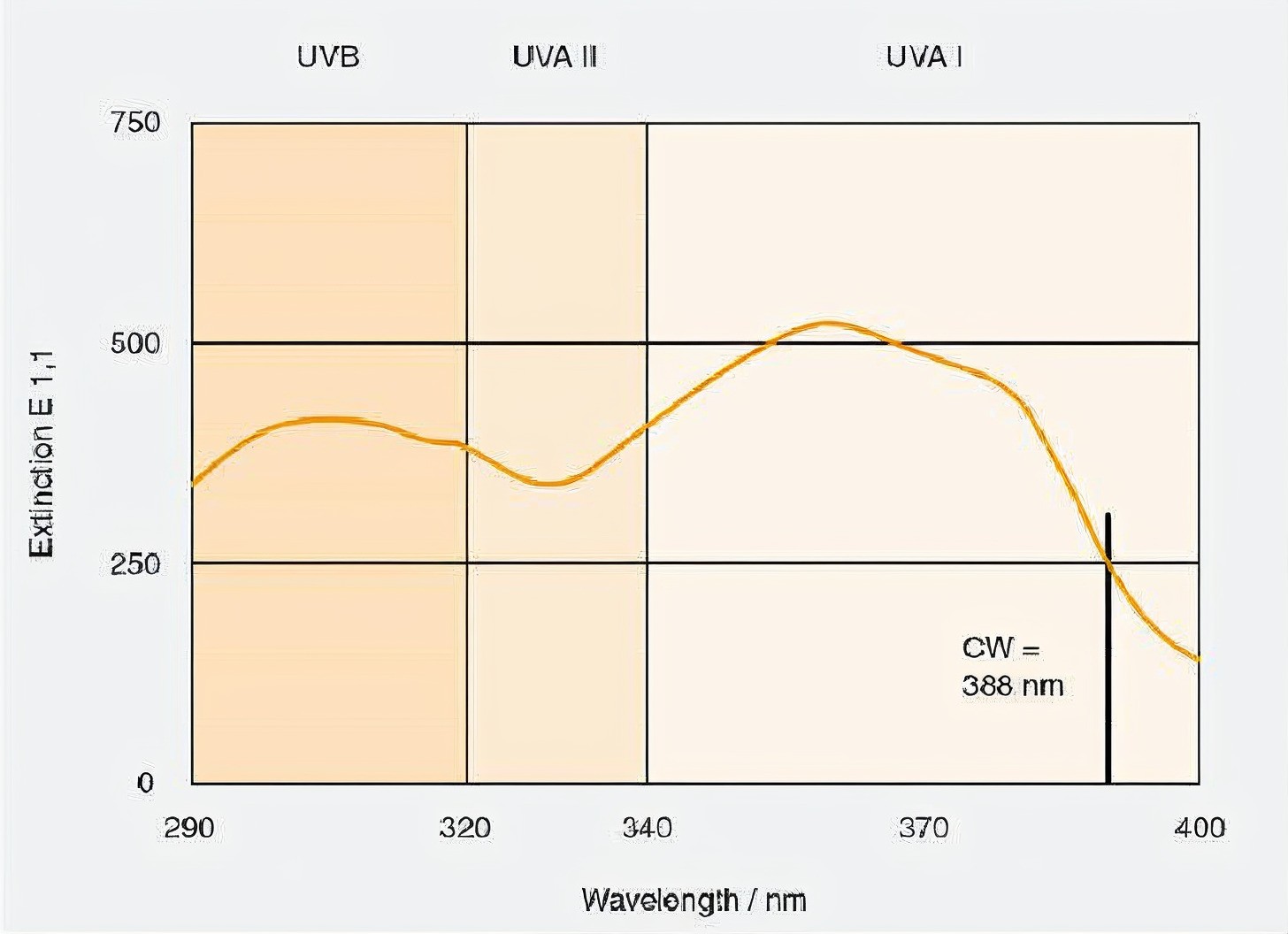
- UV profile: broad spectrum, with UV-A absorption across 350–370 nm and a maximum near 360 nm, plus UV-B absorption around 305 nm
- Typical use: 1–3% · Form: powder or aqueous dispersion
Bisoctrizole is an organic UV filter used as a particle. It is supplied and used as micronised particles below 200 nm rather than dissolved in the oil phase.
That distinction matters mechanistically. A dissolved organic filter absorbs UV and dissipates the energy as heat, full stop; the frequent claim that organic filters "reflect" light is wrong. Bisoctrizole also works mainly this way: it absorbs UV as an organic chromophore, and absorption provides most of its protection. Because it is a particle, it additionally scatters and reflects a minor share of UV, which a dissolved filter cannot do.
It shows very little photodegradation and has a stabilising effect on other UV absorbers, which makes it valuable well beyond its own absorbance.
UV spectrum of bisoctrizole
Safety studies
Bisoctrizole exhibits low toxicity by both dermal and oral routes. It caused minimal irritation applied to rabbit eyes and skin, and did not cause sensitisation, photoirritation or photosensitisation applied to the skin of guinea pigs or humans. It was not genotoxic across several assays, with and without UV activation.
An in vitro assay measured dermal penetration across human skin at 0.14%, with the remainder retained in the surface layers rather than passing through, consistent with a particulate filter that stays where it is applied.
In a 90-day subchronic oral gavage study in rats, the no-observed-effect level (NOEL) was 1,000 mg/kg/day, the highest dose tested. In a developmental toxicity study, maternal and foetal NOELs were likewise 1,000 mg/kg/day, again the highest doses tested.
Combinations with other sunscreen actives
Bisoctrizole's efficiency comes mainly from UV absorption by a photostable organic chromophore; its microfine particle structure adds a minor scattering and reflection contribution.
Practically, this makes it a strong SPF booster. Because it works in the water phase as a dispersion rather than competing for space in the oil phase, it combines readily with oil-soluble filters such as bemotrizinol and iscotrizinol, letting a formulator raise protection without making the emulsion heavier. Its photostability also helps protect more fragile actives such as avobenzone.
Regulatory status
| Country | Approval status |
|---|---|
| Europe | |
| European Union | Listed as a permitted UV filter in Annex VI of Regulation (EC) No 1223/2009. (Older documentation citing Annex VII of Directive 76/768/EEC refers to legislation repealed in July 2013.) |
| Switzerland | Included in Appendix 2 of the Verordnung über kosmetische Mittel (VKos). |
| Africa | |
| South Africa | Included under the Foodstuffs, Cosmetics and Disinfectants Act. |
| Asia and Pacific | |
| China | Included in the Safety and Technical Standards for Cosmetics. |
| Hong Kong | Sunscreens may be placed on the market without registration of raw material or finished product, provided no therapeutic claims are made and safe use is warranted. |
| India | Included in IS 4707 standards. |
| Japan | Included in the positive list under the Pharmaceutical and Medical Device Act. |
| Malaysia | No special registration for the active; finished formulations must be notified to the drug control authority. |
| Singapore | No registration of raw material or finished product required, provided no therapeutic claims are made. |
| Thailand | No special registration for the active; finished formulations must be registered with the Ministry of Public Health. |
| Taiwan | Approved by the Department of Health. |
| Australia | Approved by the Therapeutic Goods Administration (TGA) for dermal sunscreen products. |
| South and Central America | |
| Argentina, Bolivia, Brazil, Paraguay, Uruguay | Included in the Lista Positiva de Filtros Ultravioletas do Mercosul (Mercosur positive list of UV filters). |
Regulatory positions change; confirm the current national list and maximum use level before any launch. For how to read a supplier's REACH claim, see what "REACH registered" tells you.
Why bisoctrizole is almost always used in combination
Bisoctrizole is an inherently photostable broad-spectrum filter absorbing across both UV-A and UV-B, an efficient SPF booster, and a stabiliser for other UV filters. Beyond its own efficiency it improves the performance of the filters around it, which is why it is almost always used in combination rather than alone.
References
Pharmacopoeial Forum, Volume 32(2).
Next-generation UV filters for sun protection.
US Department of Health and Human Services: Time and Extent Application for bisoctrizole, UV filter.
Facts about sunscreens (American Academy of Dermatology).
Frequently asked
What is bisoctrizole?
An organic UV filter supplied as a micronised aqueous dispersion of particles below 200 nm. It absorbs across both UV-B and UV-A, with maxima around 305 nm and 360 nm, and is marketed by Vinner Labs as Sunbest-MBT.
Does bisoctrizole reflect UV light?
Only to a minor extent. It works mainly by absorbing UV as an organic chromophore, with peaks near 305 nm and 360 nm. Because it is a particulate solid rather than dissolved, it also scatters and reflects some UV, which dissolved organic filters do not, but that contribution is small next to its absorption.
Is bisoctrizole safe?
Its data package is favourable: low dermal and oral toxicity, minimal eye and skin irritation in rabbits, no sensitisation, photoirritation or photosensitisation in guinea pigs or humans, not genotoxic across several assays with and without UV activation, and dermal penetration of 0.14% in vitro.