2025-12-30 · 7 min read
A brief study on Sunbest-BMT (bemotrizinol/BEMT) sunscreen
Technical profile of Bis-Ethylhexyloxyphenol Methoxyphenyl Triazine: dual absorption peaks, photostability data, HPLC method, safety studies and market approvals.
Sun care · Formulation · Regulatory
Abstract
Background. Ultraviolet radiation is a recognised human carcinogen. The two bands reaching skin are UV-A and UV-B; both are linked to skin cancer and to UV-induced immunosuppression.
UV-B is absorbed at the skin surface and is the primary cause of sunburn. Overexposure damages cells in the basal and squamous layers and is the main driver of basal cell and squamous cell carcinoma.
UV-A penetrates more deeply, reaching melanocytes in the basal layer, and is implicated in melanoma, though UV-B contributes to melanoma risk as well, so the split is a matter of emphasis rather than a clean division.
Result. A sunscreen is a topical product (lotion, spray, gel or stick) that absorbs ultraviolet radiation and so reduces the dose reaching living skin. Two points of terminology are worth getting right. Sunscreen is not suntan lotion, which is a different product intended to promote tanning. And the common division into "physical sunscreens that reflect light" and "chemical sunscreens that absorb it" misdescribes the mechanism: at the particle sizes used in cosmetics, inorganic filters attenuate UV predominantly by absorption too, with scattering a secondary effect. The meaningful distinction is organic versus inorganic chemistry, not absorption versus reflection.
Sunscreen use reduces the incidence of melanoma and squamous cell carcinoma. Evidence for basal cell carcinoma prevention is weaker: the Nambour trial found reductions in SCC and melanoma but not in BCC.
Regular sunscreen use decreases skin cancer development, limits solar lentigines and pigment change, reduces facial telangiectasia and blotchiness, and slows photo-ageing.
Introduction
Bemotrizinol (INN/USAN) is an oil-soluble organic UV filter, supplied by Vinner Labs as Sunbest-BMT.
- INCI name: Bis-Ethylhexyloxyphenol Methoxyphenyl Triazine ("BEMT")
- Chemical name: 2,4-bis{[4-(2-ethylhexyloxy)-2-hydroxy]phenyl}-6-(4-methoxyphenyl)-1,3,5-triazine
- CAS number: 187393-00-6
- EC number: 606-111-6
- Molecular weight: 627.8 g/mol
- Also known as: BEMT, BMT, bemotrizinol
- Form: off-white powder · Typical use: up to 5%
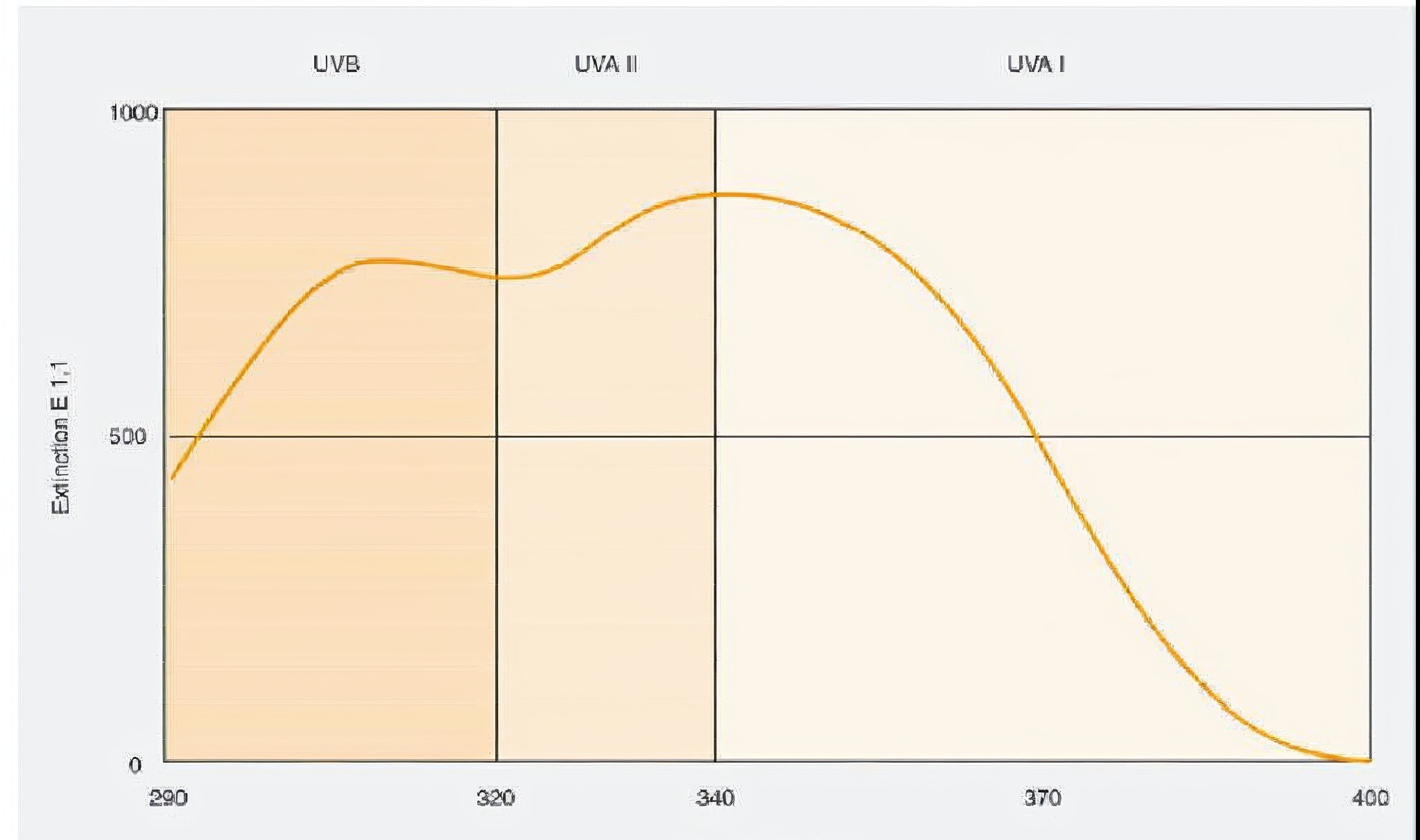
Bemotrizinol is a broad-spectrum UV absorber covering both UV-B and UV-A, with two absorption peaks, at 310 nm and 343 nm. That dual-peak behaviour in a single molecule is unusual, and it is what the "true broadband" description refers to; most organic filters have one maximum and cover one band.
It also acts as a stabiliser for other UV actives, notably avobenzone, whose photodegradation it substantially slows. Formulated with efficient UV-B filters such as ethylhexyl triazone, it shows strong synergistic SPF effects, which is why it appears so often in high-SPF systems.
Photostability data
Two figures circulate for bemotrizinol, and they were produced under different protocols. Both are given here rather than one being presented as settled.
- Manufacturer data: 98.4% remaining intact after 50 minimal erythemal doses (MEDs).
- Helioscience (France) testing: 57–58% retained absorbance.
The gap is a reminder that retention figures are only comparable when irradiation dose, film thickness and substrate are matched, and that "% intact parent compound by HPLC" and "% retained absorbance by spectrophotometry" are not the same measurement. For comparison under the Helioscience protocol, iscotrizinol retains approximately 90% and ethylhexyl triazone 76–81%. See photostability of bemotrizinol and iscotrizinol for the fuller picture.
UV spectrum of bemotrizinol
Analytical studies
A validated, stability-indicating RP-HPLC method has been developed for the simultaneous determination of ethylhexyl triazone (EHT) and bemotrizinol, with stability-indicating power established by forced degradation study.
Chromatographic separation used a Waters XBridge column with a mobile phase of acetonitrile : tetrahydrofuran : water (38 : 38 : 24, v/v/v). Sensitivity was established at limits of detection and quantitation of 0.024 and 0.08 µg for EHT, and 0.048 and 0.16 µg for bemotrizinol.
The method was validated for precision, accuracy, linearity, solution stability, specificity and ruggedness per ICH guidelines. A 2³ full factorial design with 10 runs, including two centre-point analyses, was used to estimate model coefficients and assess robustness. Analysis of variance showed all three factors, and the interactions affecting retention time for both analytes and USP plate count for EHT, to be statistically significant.
Safety studies
Bemotrizinol has been tested for phototoxicity and photoallergenicity in both guinea pigs and humans. It did not cause sensitisation, photo-irritation or photosensitisation on application to skin in either species.
It was not genotoxic across several assays, both with and without UV activation. An in vitro assay measured dermal penetration at below 0.1% across human skin. That is consistent with its high molecular weight, and the reason systemic exposure is minimal.
Efficacy
Bemotrizinol provides coverage across both the UV-A and UV-B spectrum from a single molecule, is photostable relative to older UV-A filters, has a favourable safety profile, and formulates readily into both W/O and O/W emulsions. Its strongest practical advantage is combinatorial: it raises the delivered performance of the filters around it, so systems built on it reach a given SPF at lower total filter load.
Clinical studies
- Primary skin irritation (rabbit): not irritating
- Primary eye irritation (rabbit): minimally irritating
- Skin sensitisation: not sensitising
- Phototoxicity (guinea pig): not phototoxic
- Photoallergenicity (guinea pig): not photoallergenic
Regulatory status
Approved as a UV filter in the European Union under Annex VI of Regulation (EC) No 1223/2009, and in numerous other markets including Australia, China, Korea and Taiwan. In the United States it is permitted at up to 6% under OTC Monograph M020 from 9 August 2026 (FDA final order OTC000039). In Japan it is on the UV-absorber positive list at up to 3 g/100 g, and not in products that may contact mucous membranes. REACH registered for the European Union and the United Kingdom. Confirm the current national positive list and maximum use level for any specific launch market.
Why bemotrizinol is usually used in combination
Bemotrizinol performs as a photostable broad-spectrum UV filter, compatible with both organic and inorganic filters and synergistic with UV-B filters in high-SPF systems. Beyond its own absorbance it functions as an enhancer and stabiliser for other filters, which is why it appears in combination far more often than alone.
References
Arcelin, G. (1997a). Acute dermal toxicity study with CGF-C-1607 in rats. RCC project 651420. Sponsored by Ciba Chemikalien GmbH.
Arcelin, G. (1997b). Acute oral toxicity study with CGF-C-1607 in rats. RCC project 651407. Sponsored by Ciba Chemikalien GmbH.
Time and Extent Application for Bemotrizinol: UV filter.
Pathak, M.A. Photoprotection Against Harmful Effects of Solar UV-B and UV-A Radiation. In: Lowe, N.L., Shaath, N.A. and Pathak, M.A., Sunscreens: Development, Evaluation, and Regulatory Aspects, 2nd ed., Marcel Dekker, New York (1997) 59–79.
Roy, C. and Chakrabarty, J. Development and Validation of a Stability Indicating RP-HPLC Method for the Determination of Two Sun Protection Factors.
Frequently asked
What makes bemotrizinol a broad-spectrum filter?
Two absorption maxima in one molecule: about 310 nm in UV-B and 343 nm in UV-A. Most organic filters have a single peak and cover one band, so reaching broad-spectrum status usually means combining several.
How photostable is bemotrizinol?
It depends on the test. Manufacturer data reports 98.4% remaining intact after 50 minimal erythemal doses; independent Helioscience testing under a different protocol reports 57–58% retained absorbance. Retention figures are only comparable when irradiation dose, film thickness and substrate match.
Does bemotrizinol penetrate skin?
Minimally. An in vitro assay found penetration below 0.1% across human skin, which is what its high molecular weight of 627.8 g/mol would predict.