2025-12-30 · 4 min read
The importance of inclusive shade ranges in cosmetics
Why a broad shade range is a formulation problem before it is a marketing one: undertones, iron oxide ratios, titanium dioxide flashback and pigment load.
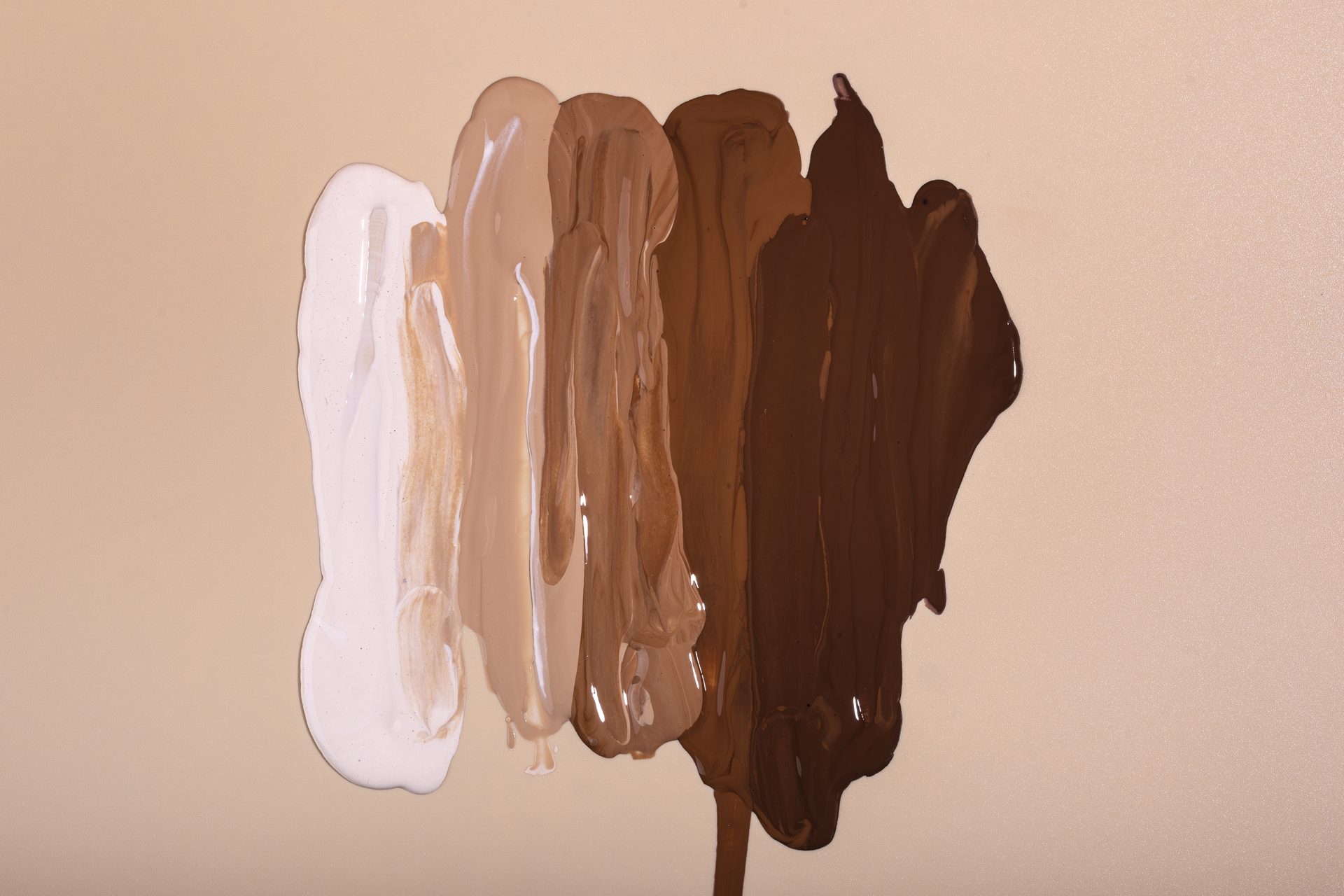
Demand for cosmetics that work across the full range of human skin tones is now taken as a baseline expectation rather than a differentiator, and many brands have expanded foundation and concealer ranges accordingly. What is less often discussed is that inclusivity is a formulation problem before it is a marketing one, and brands that treat it as the latter tend to produce ranges that fail at the ends.
How a shade range is built
Almost every foundation shade in existence is built from four pigments: red iron oxide (CI 77491), yellow iron oxide (CI 77492), black iron oxide (CI 77499) and titanium dioxide (CI 77891). The entire range comes from the ratio between them. See VINCOL Rustic Brick, Rustic Brass and Rustic Charcoal, and how to read a CI number for why the 77000-series numbers identify them as inorganic.
Two variables have to be controlled independently, and this is where ranges go wrong:
- Depth: how light or dark the shade is, governed largely by the proportion of titanium dioxide to iron oxides.
- Undertone: whether the shade sits warm (golden, yellow), cool (pink, red), neutral or olive, governed by the ratio of red to yellow iron oxide, with black modifying both.
A range that varies depth but not undertone leaves most people with a shade that matches in lightness and still looks wrong: too pink, too yellow, too grey. Olive undertones in particular were poorly served for years because they need a green-adjacent modification that a red-yellow-black system does not naturally produce.
The technical problems at the deep end
Pigment loading. Deep shades require substantially more pigment. That changes viscosity, slip, drying time, transfer resistance and wear, so a formula optimised for a mid-tone will not behave the same with three times the pigment. A properly extended range is reformulated across its depth, which is why superficial extensions perform worse at the ends than in the middle.
Titanium dioxide flashback. A specific, well-understood failure. TiO₂ scatters light strongly in the visible and near-UV, so under a camera flash it reflects far more than surrounding skin and produces a pale cast. Deep shades still need TiO₂ for opacity, which means flashback appears disproportionately on deep shades. Mitigations exist (reducing TiO₂ and building opacity differently, adjusting particle size, using treated grades), but they require the formulator to have addressed it.
Ashiness. Excess white or black pigment without adequate warmth reads grey on deeper skin. Correcting it means adding red and yellow iron oxide rather than reducing the white.
Oxidation. Foundations can shift colour on skin as the base oxidises with sebum. The shift is more visible on deep shades, which is why formulating for shade stability matters more there.
Why it matters commercially
Representation. Deep skin tones were poorly served for decades, and the effect of finding no shade that matches is not a minor inconvenience. Broad ranges signal that a brand considers its whole market.
Consumer expectation. Inclusivity is now close to non-negotiable in this category. A narrow range reads as a statement about who a brand is for.
Trust, and the tokenism problem. Range breadth is easy to fake by adding shades that are nominally different and practically unusable: poorly matched undertones, or deep shades on an unadapted formula. Consumers detect this quickly, and a badly executed extension is worse for a brand than none, because it demonstrates the intention without the investment.
Performance across the range. Coverage, finish and wear should be equivalent at every depth. Where they are not, it is usually because pigment loading was raised without adjusting the base.
What real inclusivity requires
Undertones mapped across the full depth range rather than only at the middle. Formulations adapted for high pigment loading rather than merely tinted. Flashback tested for, not assumed away. And shade development tested on the people the shades are for, which is the step that catches what a spectrophotometer does not.
Done properly this is a technical investment. Done as a numbers exercise it produces a long shade list that still does not fit anyone at the ends. See regional beauty frameworks and their preferences.
Frequently asked
What are foundation shades made from?
Almost universally the same four pigments: red iron oxide (CI 77491), yellow iron oxide (CI 77492), black iron oxide (CI 77499) and titanium dioxide (CI 77891). Depth and undertone both come from the ratio between them, which is why an entire range can be built from four raw materials.
What causes flashback in photographs?
Titanium dioxide. It scatters light strongly in the visible and near-UV, so under a camera flash it reflects far more than surrounding skin and reads as a pale cast. Because deep shades still need TiO₂ for opacity, this shows up most on deep shades and is a formulation problem rather than an application error.
Why can't a brand just darken its existing shades?
Because deep shades need substantially higher pigment loading, which changes viscosity, slip, drying time and wear. A range extended properly is reformulated across the depth range, with undertones mapped separately, which is why superficial extensions perform worse at the ends.